


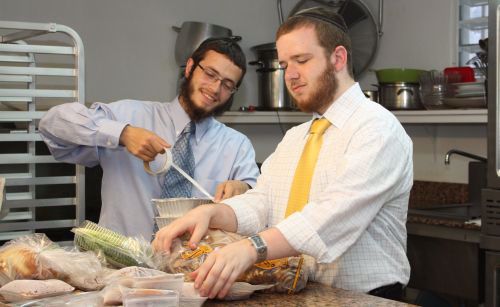
So Jews go on vacation, and vacationers need food. But where can you get kosher food in the Caribbean? One of the many changes that came about since Rabbi and Mrs. Zarchi arrived in Puerto Rico 10 years ago to establish the Chabad center is the availability of fresh, delicious kosher food delivered all over the islands.

These kosher kits go quite far. In fact, we were told that some of them have even been sent into communist Cuba!
One of the upshots of being based out of a Chabad center that doubles as a catering company is the full time chef. This is a far cry from the chicken and rice fare we know so well from yeshivah. The other day, we asked the chef for something to drink. The only problem is that she does not speak English, and we know no Spanish. In response to our gestures and motions, she bustled into the kitchen and returned triumphantly bearing a bottle of vodka! Good guess, but not quite what we were looking for.
Adios!

Response to Sarah Masha While it's true that the word adios has connotations of G-d (as does the French equivalent, adieu), it is actually a shortened version of "a D-os vos acomiendo" ("a D-eu (vous) commant") which means "I commend you to G-d." The romance language words for G-d stem from the Latin deum/deus, which in turn comes from the Proto-Indo-European "dewos," a prefix meaning god (not pleural). The mythological Zeus also has this as the source of his name. However, the origin of "dewos" appears to be "dyeu," which means to gleam or shine, and is the source of the word "day." It is possible that the deity connotation was for lightener, but equally plausible is that it stems from a sun-god meaning. Therefore, if the word adios is to be avoided, it should be in entirety due to its possible Avoda Zara (idol worship) connotation, and not due to a misinterpretation of the letter "s" indicating plurality just because it typically does in English and some other modern languages.